Vuokko Eskolin - Nurmesniemi
1930 - 2026
Biography
Vuokko Eskolin-Nurmesniemi is classed as one of the true innovators and prominent modernists in 20th century Nordic design. She has been a pioneer in Finnish fashion and is one of a number of strong women who have contributed to the international success of Nordic design. Her garments unite form and pattern constructions in a deliberate way that emphasises the overall impression, and she has always been careful to promote environmentally friendly production and quality rather than pure consumerism. Vuokko is a public person in Finland, as well as a member of the Academy of Finland. Her clothes are now worn by many celebrities, but her major breakthrough as a fashion designer came when Jackie Kennedy bought eight of her suits in 1960. She is closely linked to Marimekko, where she worked during the 1950s, and is still active in their collections.
Vuokko Eskolin was born in Helsinki in 1930. Her mother was an extremely skilled craftswoman and was a role model for Vuokko, who also enjoyed working with her hands. The only person in her family’s social circle to receive artistic training was the decorative painter Eelis Toivonen, by whom she was very impressed. Vuokko Eskolin’s mother died when she was only 14 years old, which forced her to be very independent at a young age. When she was 15 she started a summer job at Arabia’s porcelain factory. She found creative work enormously enjoyable and thus left school to start an evening course at what is now the now the University of Art and Design, Helsinki. After two years, in 1947, she started studying ceramics at the school during the day, after being unsure about choosing between textiles and ceramics. Vuokko Eskolin-Nurmesniemi later said that “making ceramics is about giving shape, and shape is important to me in everything I do”. She has also said that she is pleased she chose to train in ceramics and not textiles or fashion, because it gave her the opportunity to be much freer in her designs.
Vuokko Eskolin developed a great deal during her studies. Her desire to experiment and her independent searching for an idiom became a success. She continued working at Arabia in the summers, which was important in understanding the ceramics process. Among the other students she met her life partner, interior architect Antti Nurmesniemi. After graduating, she married Nurmesniemi in 1953 and, in the same year, was employed as head designer at Marimekko, aged just 23. At that time she had mainly worked with ceramics, but Antti Nurmesniemi had also provided her with insight and an interest in the art industry. During the 1950s there was still no extensive clothing industry in Finland and most clothes were home-sewn or ordered from small studios.
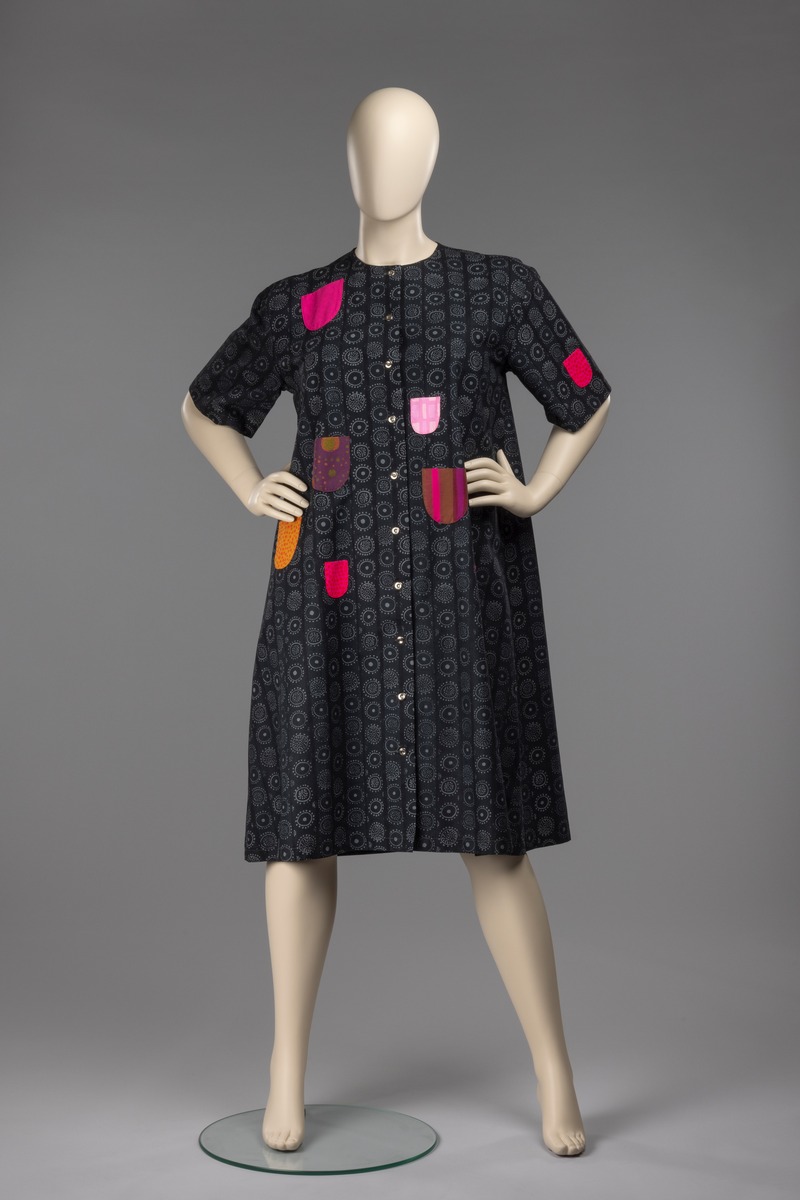
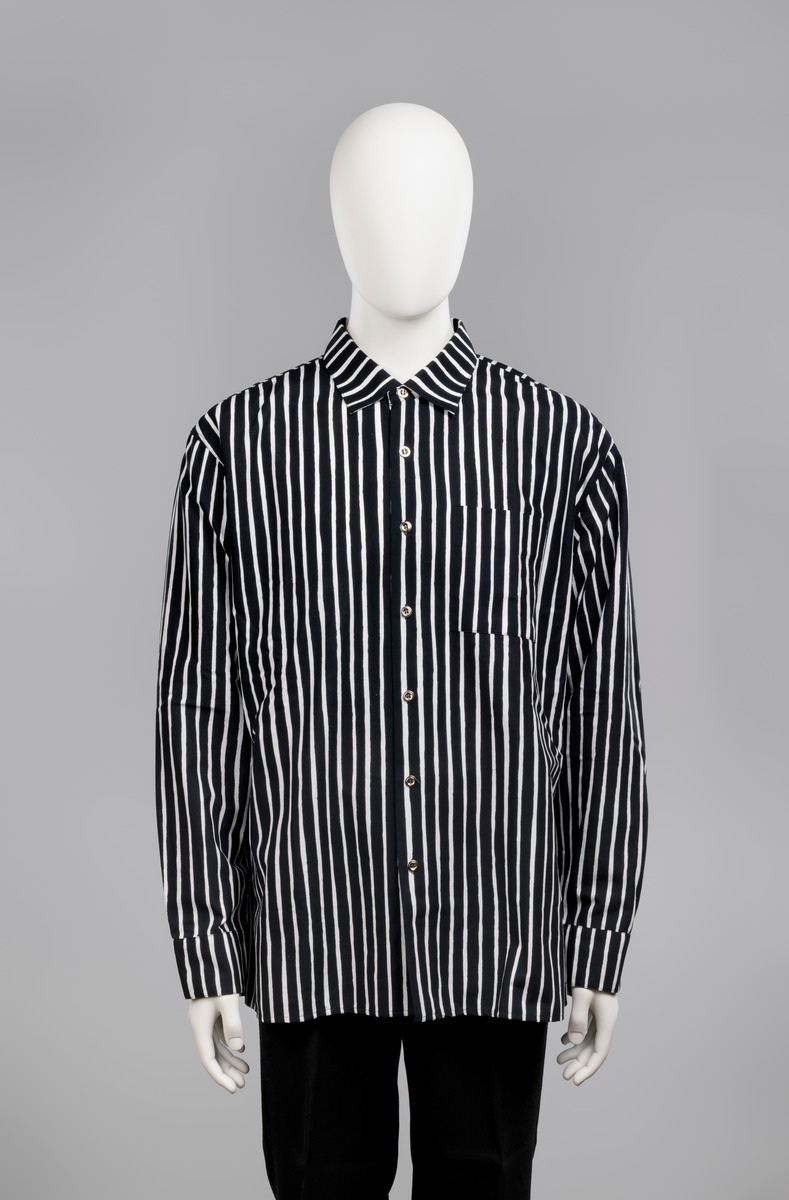
Vuokko Eskolin-Nurmesniemi left her job at Marimekko in 1960, but the company still meant a great deal to her. Her Jokapoika shirt from 1956 has been in constant production for more than 50 years, along with Illoinen Takki – the engagement dress with small, brightly coloured girls from 1960. Inspiration for Illoinen Takki came from the period that she was engaged to Antti Nurmesniemi. The idea was that the man would fill the girls with messages, presents and surprises. In 2007, Marimekko reissued some of Vuokko Eskolin-Nurmesniemi’s early designs which have had great success in the US.
It was through contacts, via her husband, that Vuokko Eskolin-Nurmesniemi met Armi Ratia who then employed her, first at Printex, which later became Marimekko. Printex had been founded in 1951 and was famous for special fabrics that were different to what was generally fashionable. The fabrics were popular but the company expanded too quickly to meet demand, which resulted in bankruptcy. It was later reborn as Marimekko and, in 1953, Vuokko Eskolin-Nurmesniemi was employed as the company’s head designer. Her task was to produce fabrics in a modernistic spirit, and she was given clear instructions by Armi Ratia and a pattern by Viola Gråsten to copy. Vuokko Eskolin-Nurmesniemi refused, and instead of following the post-war trend for black and grey and simple designs, the young designer painted the fabric with a large colourful brush. The pattern was a success and Marimekko’s “colourful era” began. Along with the other designers, Vuokko Eskolin-Nurmesniemi was completely free to create colourful patterns that looked like they’d been painted, which brought success.
Eskolin-Nurmesniemi’s success also led to her being given responsibility for Marimekko’s clothing collection. Armi Ratia’s aim was that all Finns would have one item of clothing from Marimekko. The first fashion show was held in 1954 at the Palace Hotel in Helsinki, where Vuokko Eskolin-Nurmesniemi’s fabrics and clothes were displayed. She showed straight, sleeveless blouses without collars, shirts with collars and wide wrap skirts. Instead of using silk, as was usual for summer dresses at that time, Vuokko Eskolin-Nurmesniemi used cotton, which was considered to be very practical. The show had a positive reception in the press and her style was described as “practical, simple and stylish”.
The fashion show that was held two years later, 1956, was the first time that Vuokko Eskolin-Nurmesniemi used her own fabrics for clothing and there was considerable praise from the fashion press and the general public. The patterns and garments were called “fireworks of colours”. The fashion show gave Vuokko Eskolin-Nurmesniemi the status of a fashion designer but, even more importantly, was that fashion came to be regarded as part of the Finnish art scene.
In 1959, Marimekko made its US debut in the city of Cambridge, where Benjamin Thompson’s company, Design Research, started to sell Marimekko fabrics and clothes. The progressive clothes had a positive reception the university town of Cambridge and the bold colour combinations received special attention. Marimekko’s clothes came to be associated with intellectual circles, and there was a great deal of publicity when Jacqueline Kennedy bought eight Vuokko Eskolin-Nurmesniemi sundresses and, beside her husband, then president, wore a Marimekko on the cover of Sports Illustrated in 1960.
In 1960, the fashion designer and her husband, Antti Nurmesniemi, who had been awarded the Lunning Prize the same year, travelled to India. When Vuokko Eskolin-Nurmesniemi returned from the trip she decided to start her own company rather than continue working at Marimekko: Vuokko Oy. She designed fabrics and clothes, and her designs became increasingly simplified and more graphic. Vuokko Eskolin-Nurmesniemi left behind the girlish style of the clothes she made for Marimekko, and her clothes became more adult with narrower cuts and more volume. Her collection also included press studs, zips and velcro, which was extremely modern at that time.
Vuokko Oy’s first collection, which was launched in 1964, had a positive reception and Vuokko Eskolin-Nurmesniemi was counted as one of Finland’s foremost fashion designers. She also received the prestigious Lunning Prize, which was a true recognition of her work. Vuokko Eskolin-Nurmesniemi’s style was absolutely of the times, using bright colours and repetition. She was also asked to design a number of official uniforms in the 1960s, including suits for Finnair’s air hostesses and for the first women priests in Finland.
In the 1980s, much of the Finnish clothing industry moved to low wage countries, and many fashion companies were forced to close. Vuokko Eskolin-Nurmesniemi refused to compromise on quality and production and thus kept manufacturing in Finland, which resulted in her company going bankrupt in 1988. Many people in Finland were worried about what would become of this star of Finnish design.
However, in 1993 she started a new business, now under the name of Vuokko Nurmesniemi. Her store, VUOKKO, opened on Norra Esplanaden in Helsinki and her business was founded on the same principles as before. The clothes were made of natural materials and old patterns and styles were reused in new variations. Linen was also launched alongside cotton, silk and wool. Vuokko Eskolin-Nurmesniemi received the prestigious Kaj Franck Design Prize in 1997.
Vuokko Eskolin-Nurmesniemi and her husband, Antti Nurmesnimi, are among the most famous designer couples in Finland and the Nordic region. They belong to the group of young designers of the 1950s and 1960s who contributed to the spread of Finnish design abroad. They came to be called “hero designers”; in their homeland they were celebrated as heroes and public figures because they helped to put Finland on the map. Their first joint show was held in 1957. Antti Nurmesniemi worked for Artek and had made storage furniture for offices and homes, while Vuokko Eskolin-Nurmesniemi showed ceramics and a black and white fabric called Kakemono. The show was considered to be “exotic”, and the Nurmesniemis talked about the inspiration that a journey in southern Italy had given to their colours and shapes.
They were both modernist and promoted Finnish design abroad. The creation of their home in Brändö, in 1976, made it a work of art, where he was responsible for the architecture and she was responsible for decoration and textiles. The house is a modernist masterpiece, with large glass walls that let in the forest and the sea, and the open plan design on different levels creates free areas and a functional atmosphere. The main materials were aluminium, wood and glass, and the flat roof was held up by a visible construction of solid iron bars. The Nurmesniemis, who were a symbol of modernist Finnish design, allowed their home to reflect their simple, bold style.
Vuokko Eskolin-Nurmesniemi defines herself as an artist. Fashion designer is a title about which she is hesitant, because there is something superficial and trendy about the idea of fashion. “This job is not creation, it’s design and, as such is even fairly simple. The clothes are born on the paper, next to the fabric pattern,” she says. Her fashion creations are more sculptural than tailored.
She therefore prefers to use the word design rather than fashion when talking about her collections, and her own understanding of her work is that it is closer to that of an industrial designer than that of someone who creates fashion.
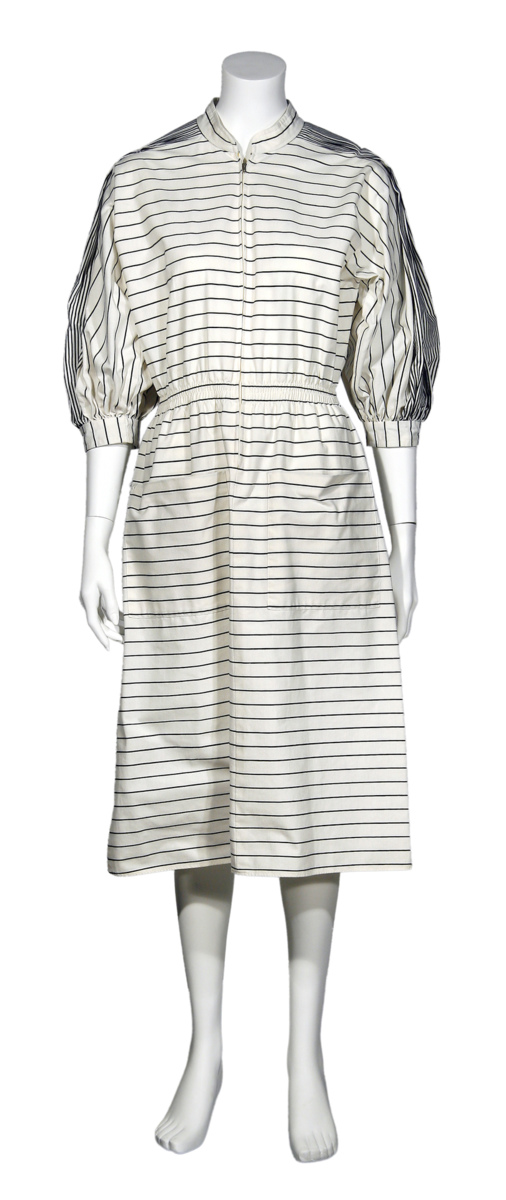
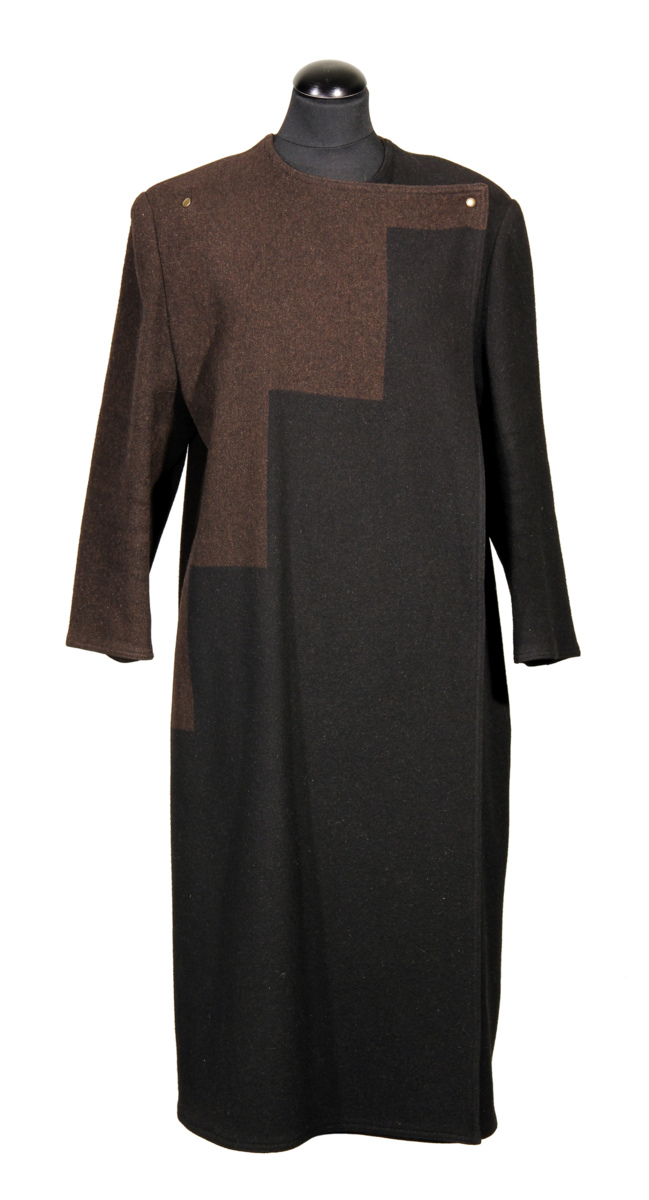
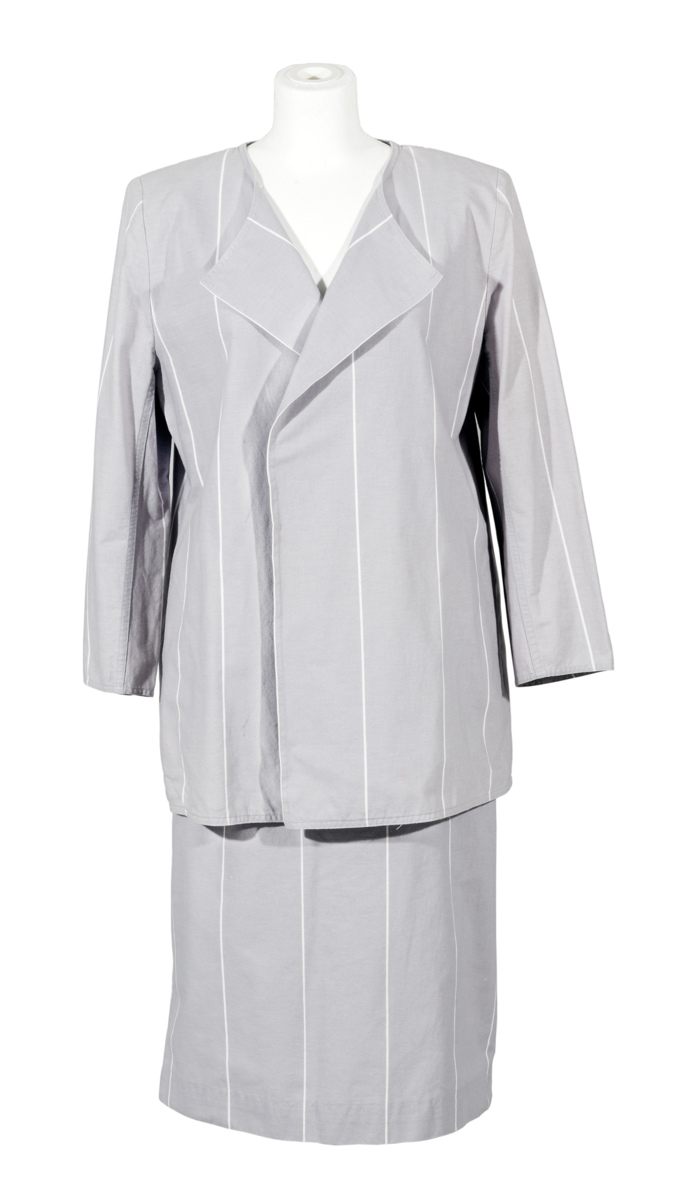
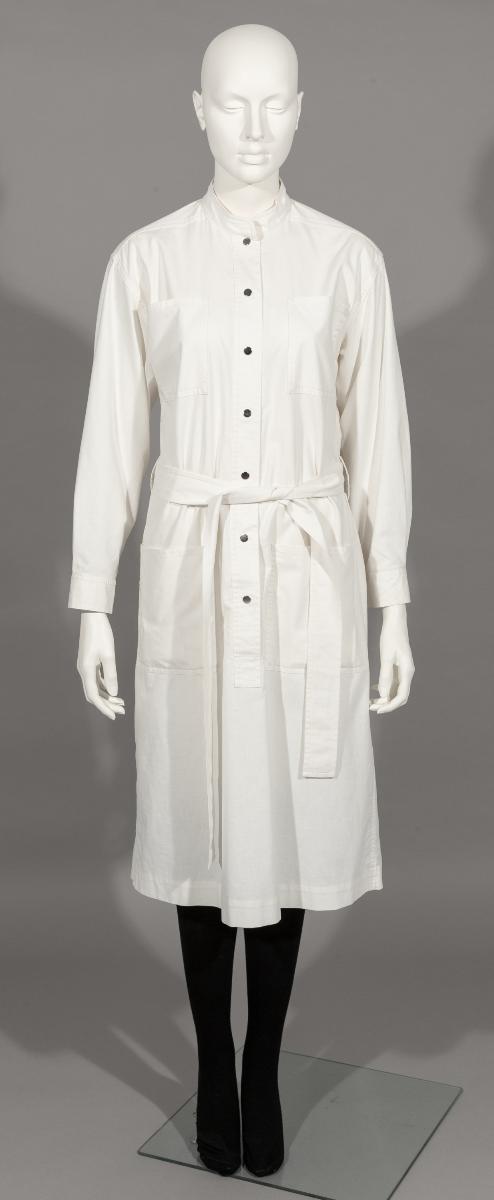
Despite this, the fact remains that she is an extremely successful fashion designer. Her clothing collections are based on simple cuts and graphically distinct fabrics, and she has consistently followed the same principle throughout all of her production. The cuts of the garments skilfully echo and supplement the abstract lines of the patterns. Her garments are available in several colourways, they are functional and easy to wear, and she makes only a few in each series to preserve their originality. Her fashion profile has mainly been timeless casualwear, reinforced by bold designs and strong colours. Vuokko has always strived to create clothes that are simple, versatile and independent of trends. Her role models include Chinese robes, the Japanese kimono and the Indian sari. Her design process has always focused on quality and aesthetics and, since the start, has always lived its own life alongside trends.
Since the 1960s, Vuokko Eskolin-Nurmesniemi’s long, dramatic evening kaftans, monochrome, comfortable and rich in flowing fabrics, have been uniquely depicted by the photographer Max Petrelius. He strengthened and enhanced the graphic feel by copying the model several times into the same photo. This partnership was very important in creating the feel of Eskolin-Nurmesniemi’s characteristic style and fashion idiom.
Few people can boast of being a living classic, but Vuokko Eskolin-Nurmesniemi is one of them. Ever since her debut, she has created fabrics and garments that have questioned traditional means of expression. Her patterns move between strict, sparse geometry and those that are dramatic and colourfully oversized. Her garments are a unique symbiosis of form and pattern, uniting a personal idiom with efficient production and clean, simple garments. She has also succeeded in following her own path and remaining outside transient fashions. Her design has contributed to freeing the female form from the impractical and uncomfortable clothes that were fashionable in the 1950s. Instead, she introduced practical, easy-to-wear fashion for every woman. Vuokko Eskolin-Nurmesniemi has also inspired many young, contemporary designers both inside and outside Finland.
Objects