Object
Faience
, 1942
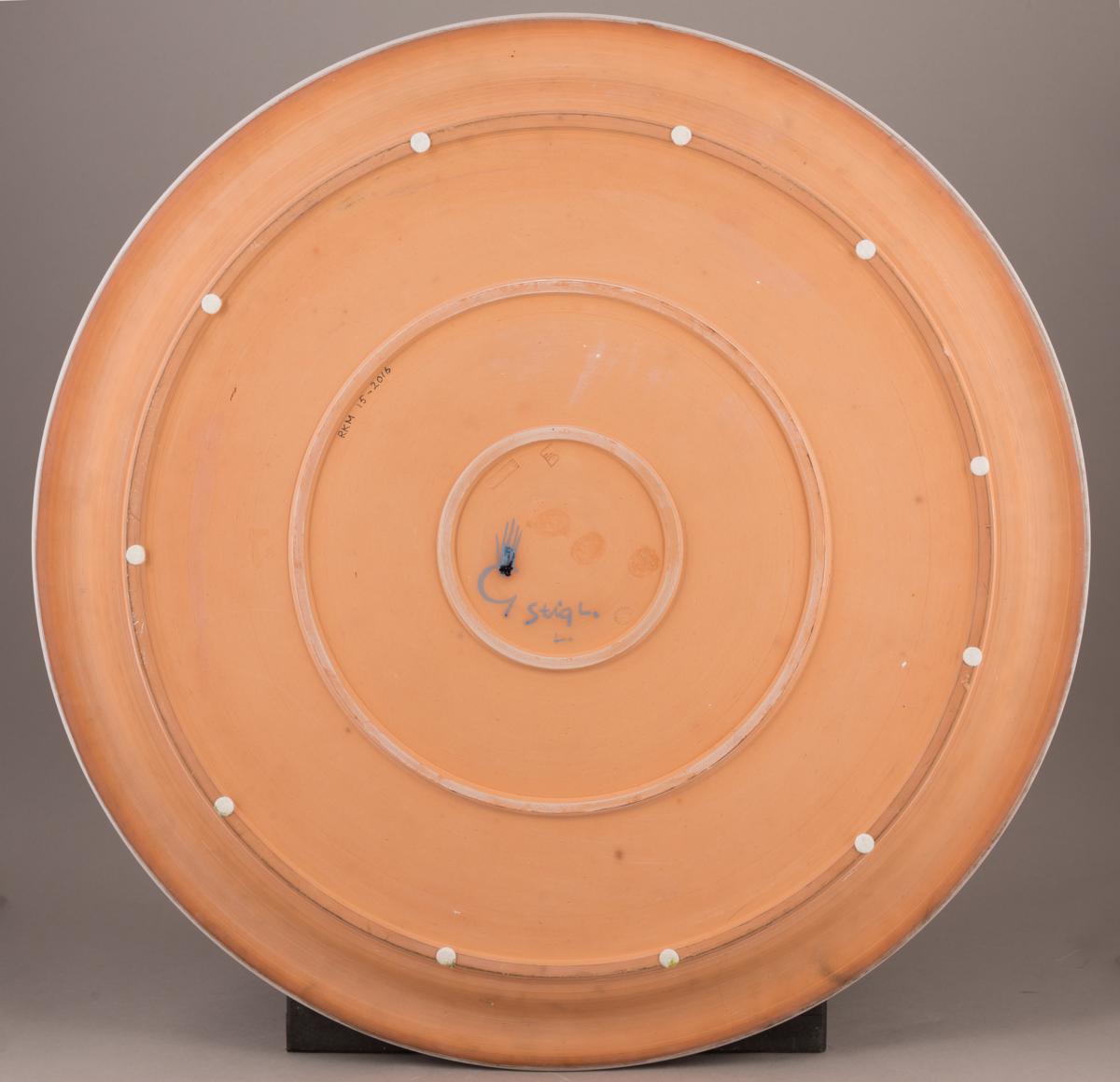
RKM 15-2016
Purchase
Currently not on display
Description
Stig Lindberg debuted with stoneware in a group exhibition in 1941 but his true breakthrough came a year later with the exhibition Fajanser målade i vår (Faience pieces painted this spring) in Gustavsberg’s showroom in Stockholm. The exhibition presented pieces by Lindberg and his older colleague and mentor Wilhelm Kåge. In the following year, a new group of the same type of objects was also shown at the Röhsska Museum under the title Fajanser från Gustavsbergs Studio (Faience pieces from Gustavsberg Studio). After the exhibition, the museum’s curator Gustaf Munthe highly praised Lindberg’s “painterly joy and delight in fantasising” in Sweden’s Form magazine.
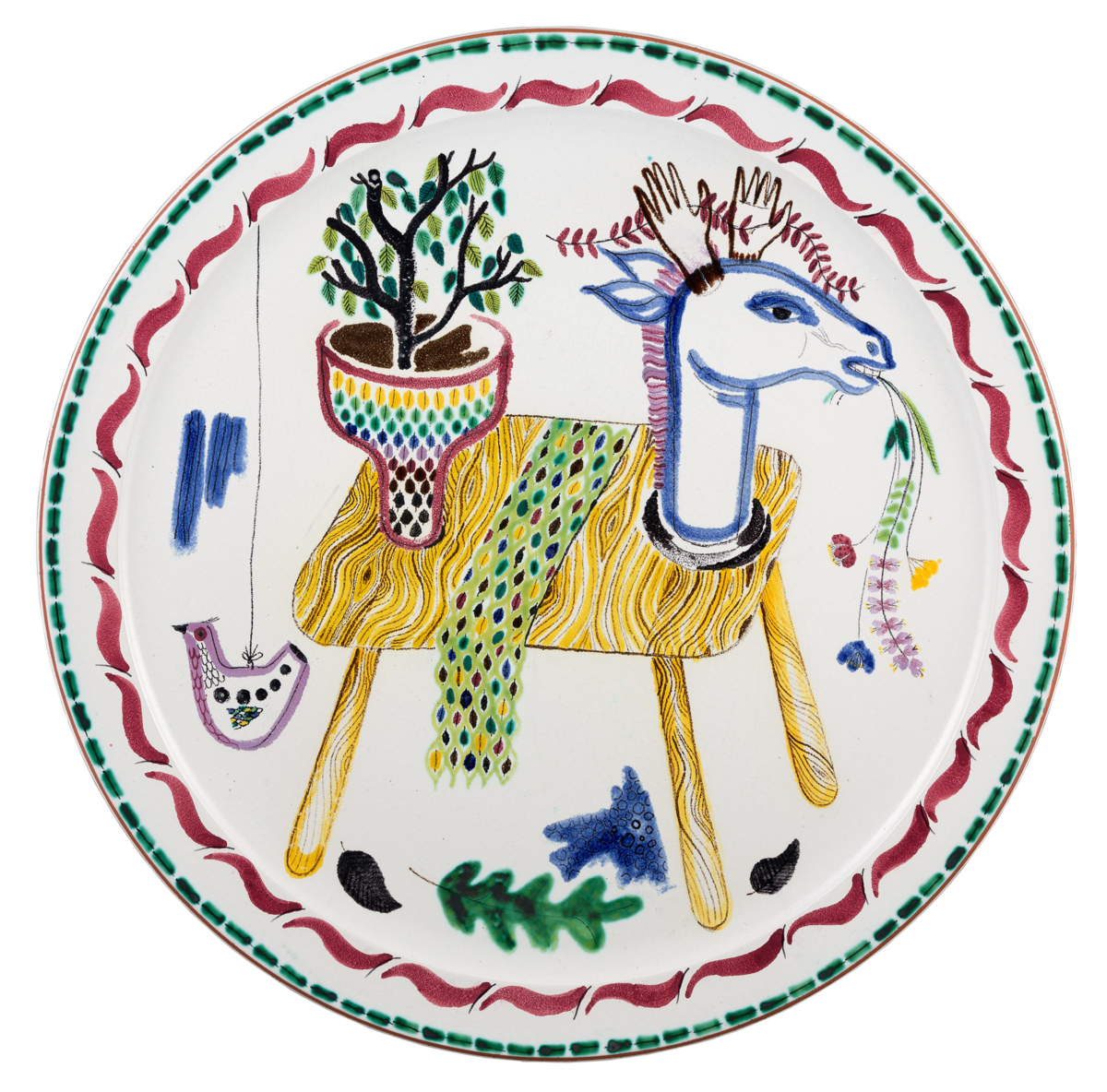
This large unique plate was part of the 1943 exhibition. The plate depicts a footstool on which stands a sculpture in the form of a deer’s head. The deer’s antlers are human hands. The stool with its four legs functions as the deer’s body. The transitions between object, animal and human are typical of Lindberg’s imagery at that time and indicate inspiration from Surrealism. Lindberg had previously used the motif of a deer’s head with antlers composed of human hands in a stoneware sculpture in 1939.
Faience is a clay body covered with white tin glaze onto which a coloured pattern is painted. The critics and public of the 1940s appreciated the colourful pottery, and Gustavsberg soon launched extensive series manufacturing, for which Lindberg successively designed new models and patterns until 1962, when the faience department was closed. A brief relaunch occurred in 1966 with the exhibition Fajansigen (Faience again), which contained vessels with horizontal striped patterns.
Exhibition History
Prunus, Tahiti och Batalj - Stig Lindberg i samlingarna, Göteborg, Röhsska museet, 22/06/2016 - 28/08/2016